Tag: AI

  • AI efficiency and effectiveness

    AI efficiency and effectiveness

    In the previous episode, we discussed modern multi-tenancy, including why application-level multi-tenancy is unnecessary in modern infrastructure. In this episode, we tackle AI efficiency and effectiveness.

    There’s now broad acceptance that AI doesn’t unlock whole-system benefits when it’s applied to the wrong places, or when teams lack the foundations to support it.

    Read on to find out why AI is creating a new kind of gatekeeper, why there’s less pressure to say no to features, and why you need to treat your deployment pipeline like a pizza oven.

    Watch the episode

    You can watch the episode below, or read on to find some of the key discussion points.

    The infuriating AI gatekeeper

    By now, most of us have been on the receiving end of a terrible interaction with an organization that’s put an AI chat tool in front of their support or customer service. We can formalize and explore this problem using the beneficiary user and end user types:

    • Beneficiary user: The person benefiting from making a task easier using AI.
    • End user: The person interacting with the AI or its output.

    Sometimes these are the same person, but in many cases, the beneficiary user enjoys a reduced workload while the end user has to run a chatbot gauntlet, review a 15-page vibe-written strategy document, or deal with a poor automated decision.

    The ethics of scale explains how to use automation responsibly, and the same thinking applies to how we affect other people through our use of AI.

    There’s less pressure to say no

    We no longer need to say no to a feature just because we assume AI will make it cheap and fast to build. That removes a pressure many product managers have relied on to keep their roadmap in check, which makes strong product management, backed by a clear product vision, more important than ever. Without it, products become bloated with features, overwhelming users with too many options and losing the simplicity of a curated, opinionated feature set.

    Many organizations decline features only because they don’t have the capacity to build them all. If these teams lose that natural mechanism for trimming their roadmap, they might add features that don’t improve the product for most users. That makes the software less valuable, because it becomes harder to understand, harder to use, and harder to maintain.

    The software delivery pizza oven

    You need certain foundations in place to deliver software in a way that optimizes for feedback. The pizza oven analogy helps illustrate why.

    Making a pizza starts with a human process: the dough is hand-stretched, and the toppings are added. Once that’s done, the pizza moves onto a conveyor belt that carries it through the oven at a fixed speed, so it’s always cooked properly and safe to eat.

    Software delivery should work the same way. Humans apply their unique skill and taste to create change, then that change travels through a deployment pipeline that checks it works and is safe to use.

    Either way, speed only matters end-to-end. There’s no point preparing a pizza if you can’t get it through the oven, and no point stacking up cooked pizzas if customers aren’t ordering and enjoying them.

    Too many teams speed up pizza preparation without a good oven. That’s the start of a painful downward spiral toward large-batch, high-risk, high-failure software delivery.


  • CD Office Hours Ep.9: The compliance ratchet

    CD Office Hours Ep.9: The compliance ratchet

    Continuous Delivery Office Hours Ep.9. The compliance ratchet
    Continuous Delivery Office Hours
    CD Office Hours Ep.9: The compliance ratchet
    Loading
    /

    In this episode of Continuous Delivery Office Hours, Steve Fenton is joined by Octopus Deploy founder Paul Stovell to explore the hidden bottleneck in the AI productivity conversation that nobody is talking about: compliance and risk tolerance.

    Everyone wants code written faster, so they are turning to AI to make it happen. But the constraint is never coding speed, it’s the organization’s appetite for change… and that means things are about to get more painful.

    The physics of organizations means faster change generation will create an equal and opposite reaction in risk-averse environments that introduces irreversible road blocks.

    Listen to find out more about:

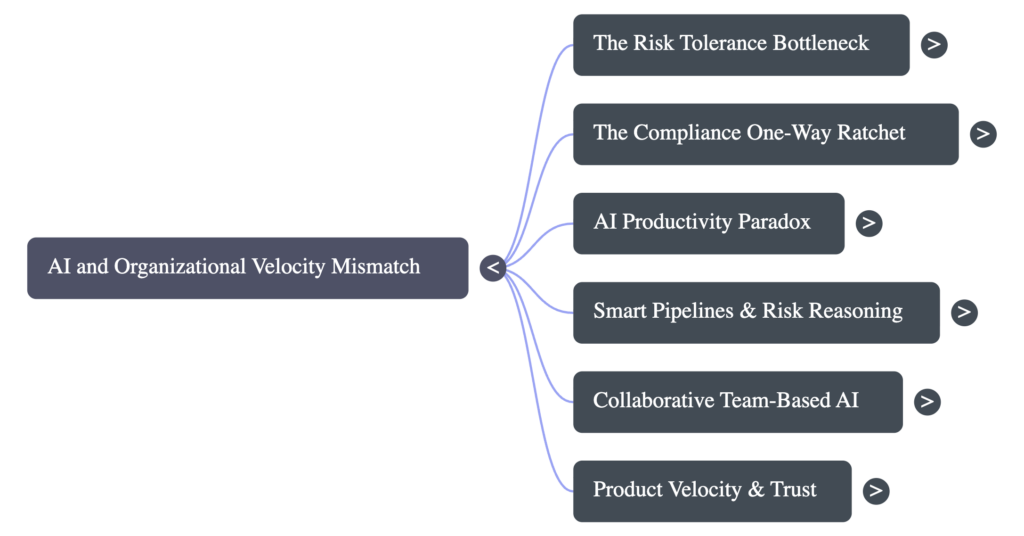
    • Why developer velocity was never the real bottleneck in regulated organizations
    • The compliance ratchet: why risk requirements only ever go up, never down
    • How AI could be applied to risk assessment rather than just code generation
    • Why fragmented on-machine AI agents are creating a UX coherence crisis
    • The product velocity bullseye and why direction matters as much as speed How to avoid inviting regulation by rolling out AI responsibly

    Episode details

    Episode mind map showing AI and organizational velocity mismatch leading to a risk/tolerance bottleneck, the one-way ratchet, the productivity paradox, smart pipelines, risk reasoning, collaborative team-based AI and trust

    You can also watch episodes on YouTube.

  • CD Office Hours Ep.8: AI efficiency and effectiveness

    CD Office Hours Ep.8: AI efficiency and effectiveness

    Continuous Delivery Office Hours Ep.8. AI efficiency and effectiveness
    Continuous Delivery Office Hours
    CD Office Hours Ep.8: AI efficiency and effectiveness
    Loading
    /

    In this episode of Continuous Delivery Office Hours, Tony Kelly, Bob Walker, and Steve Fenton discuss some of the tangled pathways around AI, the search for efficiency and productivity, and the need to re-focus on effectiveness and outcomes.

    You’ll find out about the beneficiary user versus end user divergence and where asymmetry can cause bad outcomes for end users and, ultimately, organizational goals. This leads to why the organizations succeeding with AI had the right foundations in place before their AI adoption.

    Listen to find out more about:

    • Beneficiary and user asymmetry and how it damages your business
    • The old measurement mistakes that are resurfacing alongside AI
    • Why developer productivity might not be moving the needle for your teams
    • How to easily predict whether an organization will be successful with AI
    • A pizza-oven metaphor for your software delivery

    Episode details

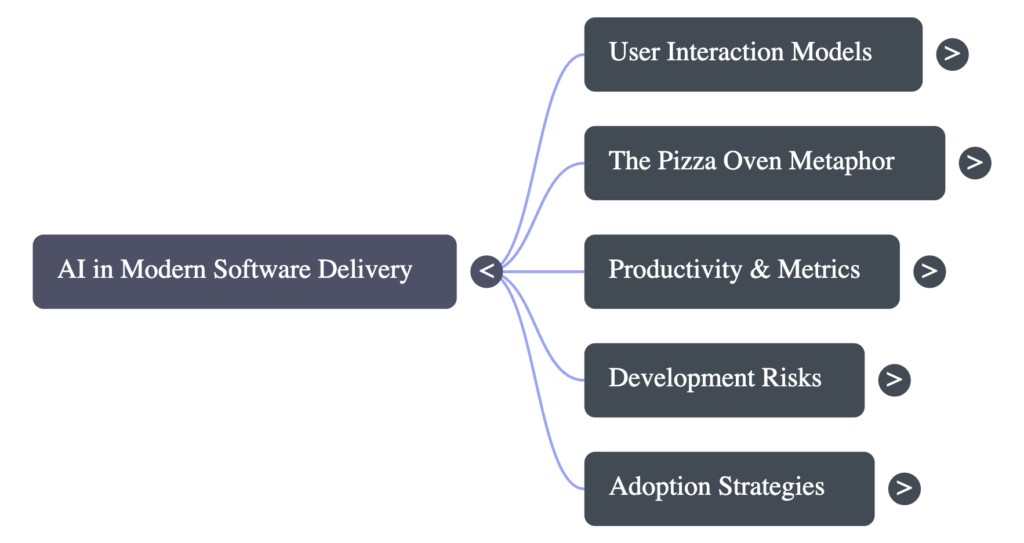
    Episode map showing AI in modern software delivery with nodes for user interaction models, the pizza oven metaphor, productivity and metrics, development risks, and adoption strategies

    You can also watch episodes on YouTube.